Contact Now

The United States remains a top destination for global talent, particularly for those in STEM (Science, Technology, Engineering, and Math) fields. However, as of March 2026, the immigration landscape has become more selective, with a shift toward "merit-based" criteria and enhanced security screenings.
1. Key Immigration PathwaysA.
For Professionals: H-1B Visa (New Rules)
The H-1B lottery has been replaced with a Weighted Selection Model.
High-Wage Priority: Instead of a random draw, USCIS now prioritizes applicants with higher offered salaries relative to their local market.
Master’s Cap: The 20,000 slots for those with a U.S. Master’s degree remain, but the competition is now based on qualifications and wage levels.
New Fees: A $250 Visa Integrity Fee and a significantly higher registration fee are now standard to fund enhanced anti-fraud measures.
B. For High-Skilled Talent: EB-1 & EB-2 NIW·
EB-1 (Extraordinary Ability): For researchers, professors, and executives. It offers the fastest path to a Green Card, often waiving the need for a specific job offer.
EB-2 NIW (National Interest Waiver): Increasingly popular for doctors and engineers. You can "self-petition" for a Green Card if you can prove your work significantly benefits the U.S. economy or healthcare system.
C. For Students: F-1 & STEM OPT
The STEM OPT extension continues to allow graduates in technical fields to work for up to 3 years after their degree. This remains the primary "bridge" to an H-1B or Green Card.
2. Advantages of a U.S. Green Card (Permanent Residency)
Securing a Green Card in 2026 provides several life-changing benefits:
Unrestricted Work Rights: You can work for any employer, start your own business, or work as a freelancer without needing visa sponsorship.
Education Cost Savings: * Domestic Tuition: You pay "In-State" rates at public universities, saving an average of $30,000 per year compared to international students.
. Federal Aid: You become eligible for FAFSA, Pell Grants, and low-interest federal student loans.
Family Sponsorship: You can petition for your spouse and unmarried children under 21 to join you as permanent residents.
Social Security & Medicare: After working for 10 years (40 quarters), you qualify for federal retirement and healthcare benefits.
Path to Citizenship: After 5 years of holding a Green Card (3 years if married to a U.S. citizen), you can apply for a U.S. passport.3. Important 2026 Policy ShiftsIf you are applying this year, be aware of these new procedural hurdles:
Enhanced Vetting: A new "Vetting Center" now reviews social media and online presence for H-1B and H-4 applicants. Ensure your professional profiles (like LinkedIn) are accurate and consistent.
The Public Charge Rule (2026 Edition): Immigration officers now have broader discretion to deny Green Cards if they believe an applicant is likely to rely on certain public benefits (like Medicaid or SNAP) in the future.
Processing Holds: As of January 2026, there is a temporary adjudicative hold on applicants from certain "high-risk" countries. While India is generally not on this list, travel history to specific regions may trigger additional interviews.
Immigrating to Canada in 2026 offers a unique combination of high-tier social protections and a newly refined, "purpose-driven" selection process. While the system has become more selective to ensure sustainability, the benefits for those who secure Permanent Residency (PR) remain some of the most comprehensive in the world.
1. Top Advantages of Canada PR·
Universal Healthcare: PR holders and their families access Canada’s publicly funded healthcare system. Most essential medical services, from doctor visits to hospital stays, are covered through taxes rather than out-of-pocket payments.
Education for Children: Your children can attend high-quality public primary and secondary schools (up to Grade 12) for free. For university, PR holders pay domestic tuition rates, which are significantly lower than international fees.
Social Safety Net: * Employment Insurance (EI): Financial support if you lose your job.
Canada Child Benefit (CCB): Tax-free monthly payments to help with the costs of raising children.
New 2026 Benefits: Starting in Spring 2026, the Canada Groceries and Essentials Benefit provides targeted inflation relief for low- and modest-income residents.
Path to Citizenship: Canada remains one of the fastest routes to a powerful global passport. After living in Canada for three out of five years as a PR, you are eligible to apply for full citizenship.
2. Key Immigration Shifts in 2026
The "recalibration" of 2026 means Canada is moving away from high-volume intake toward targeted selection.
The "In-Canada" Advantage: 2026 marks a massive shift toward "temporary-to-permanent" transitions. A new TR to PR pathway is launching to help 33,000 workers already in Canada secure residency.
Priority Occupations: Express Entry is no longer just about high scores; it is about what you do. The 2026 categories specifically target:
Healthcare: Special focus on doctors and nurses with Canadian experience.o STEM & Tech: To drive innovation and AI sectors.
Skilled Trades: Construction, plumbing, and electrical work to address the housing shortage.
French Proficiency: High priority for those who can work in French, even outside Quebec.
International Student Changes: While overall study permits are capped, Master’s and Doctoral students at public institutions are now exempt from certain "attestation" hurdles, making their path to PR smoother and faster.
3. Benefits for Indian Immigrants
With a record 127,000 Indians becoming PRs recently, the community support is a major benefit:
Cultural Familiarity: Established Indian hubs in cities like Brampton, Surrey, and Calgary offer familiar food, festivals, and strong professional networks.·
Family Sponsorship: As a PR, you can sponsor your spouse and dependent children immediately. Programs for parents and grandparents also exist, though they are subject to specific intake windows.·
Global Recognition: A Canadian degree or work experience is highly valued in the US and Europe, giving you massive career leverage.
The UK immigration system in 2026 is currently undergoing its most significant shift in years.
Following the 2025 "Restoring Control" White Paper, the government has moved toward a more selective, points-based model with stricter integration and financial requirements.
Here is a breakdown of the key changes and current rules as of March 2026.
1. The Points-Based System (Skilled Worker Visa)To qualify for a work visa, you must score at least 70 points. Most of these are "mandatory," while others can be "traded" based on your specific situation.Mandatory Requirements (50 Points)·
Job Offer (20 pts): Must be from a Home Office-approved licensed sponsor.
Skill Level (20 pts): The role must generally be at RQF Level 6 (degree-level) or higher.
English Language (10 pts): As of January 8, 2026, the requirement has increased from B1 to B2 level (upper-intermediate) for all new Skilled Worker, Scale-up, and High Potential Individual applicants.Tradeable Requirements (20 Points)You must earn an additional 20 points, usually via salary:
General Salary Threshold: Generally £41,700 or the "going rate" for the specific job, whichever is higher.
Lower Thresholds: You may still qualify with a lower salary (around £33,400) if you are a "New Entrant" (e.g., switching from a Graduate visa) or if the job is on the Temporary Shortage List (TSL).
2. Recent "Statement of Changes"
(March 2026)A major update was published on March 5, 2026, introducing several emergency and structural measures:
The "Visa Brake": Starting March 26, 2026, the UK will temporarily stop issuing sponsored Student visas to nationals of Afghanistan, Cameroon, Myanmar, and Sudan, and Skilled Worker visas to Afghan nationals.
This is a measure to manage asylum claim volumes.
Indian Nationals Concession: Under the UK-India trade pact, a new Service Supplier route opens on March 25 with an 1,800-person annual quota, allowing Indian professionals to deliver contracted services in the UK for up to 12 months.
Stricter Salary Compliance: Employers must now prove that sponsored workers meet the required salary level in every individual pay period, rather than averaging it over a year.
Electronic Travel Authorisation (ETA): As of February 25, 2026, the ETA is mandatory for visitors from over 85 countries (including the EU, US, and Canada). You must have digital approval before boarding your flight.
3. Post-Study & Settlement
If you are currently studying in the UK or planning to, the pathways to staying permanently are tightening:Graduate Visa Changes·
Current Duration: 2 years (3 years for PhDs).
Upcoming Change: For applications made on or after January 1, 2027, the duration for non-PhD graduates will be reduced to 18 months.
This gives you a shorter window to find a sponsored job.The "Earned Settlement" Model (April 2026)The government is moving away from the standard 5-year route to Indefinite Leave to Remain (ILR):
Standard Wait: Expected to increase from 5 years to 10 years for many routes.
Accelerated Settlement: You may "earn" your way back to 3 or 5 years if you are a high earner (e.g., earning over £125,140) or hold a Global Talent visa.
Refugee Status: As of March 2026, the initial grant for refugees has been reduced from 5 years to 30 months.
4. Financial Requirements
(2025–2026)Student visa maintenance funds have increased to reflect the cost of living:
Inside London: £1,529 per month.
Outside London: £1,171 per month.
Immigration Health Surcharge (IHS): Standardly £1,035 per year for most visa types.
Note: These rules are subject to rapid change. If you are preparing an application, I recommend verifying your specific SOC (Standard Occupational Classification) code against the latest Home Office salary tables.
Germany has significantly modernized its immigration laws to attract skilled talent, particularly through the Skilled Immigration Act and the new Opportunity Card. As of March 2026, the system focuses on faster processing and lower barriers for qualified professionals.
1. The EU Blue Card (Skilled Professionals)
The Blue Card remains the primary route for university graduates and high-skilled workers.
The salary thresholds are updated annually and for 2026 are as follows:
Standard Occupations: A minimum gross annual salary of €50,700.·
Shortage Occupations & New Entrants: A reduced threshold of €45,934.
This applies to: STEM fields: Mathematics, IT, Science, Engineering, and Human Medicine.
Young Professionals: Graduates who obtained their degree within the last 3 years.
IT Specialists: You can now obtain a Blue Card without a university degree if you have at least 3 years of relevant professional experience and meet the €45,934 salary threshold.
2. The Opportunity Card (Chancenkarte)
Launched to allow people to look for work while living in Germany, this points-based visa is valid for one year.Basic Requirements (Mandatory)·
Education: At least 2 years of vocational training or a university degree (recognized in your country of origin).
Language: German A1 or English B2.
Funds: Proof of approximately €13,092 for the year (e.g., via a blocked account).Scoring System (Need 6 Points)If you aren't already a "recognized skilled worker," you must score points based on:
Language: Up to 3 points for German (B2+) or 1 point for English (C1+).
Experience: 2–3 points for work experience related to your qualification.
Age: 2 points if under 35; 1 point if between 35 and 40.
Connection: 1 point for a previous 6-month stay in Germany.3. Pathways to Permanent Residency & Citizenship
Germany has drastically shortened the timelines for staying permanently:
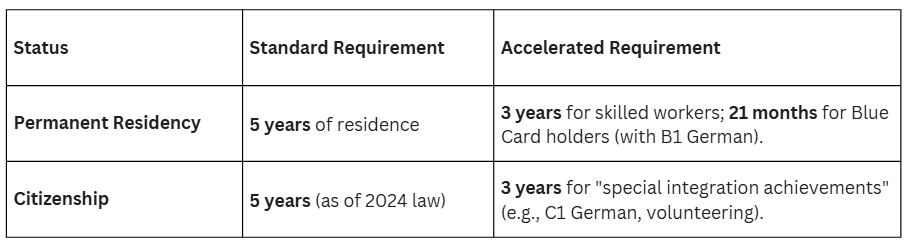
Note: Dual citizenship is now generally permitted under the new 2024/2025 reforms, meaning you likely won't have to give up your original nationality to become German.
4. Key 2026 Updates·
Employer Obligations: Since January 1, 2026, employers must inform new international hires of their rights to labor and social counseling on their first day of work.
Digitalization: Most applications are now handled through the Consular Services Portal, reducing the need for multiple in-person embassy visits.
Work Flexibility: If you have a recognized degree, you are no longer restricted to working only in a field directly related to your studies (except for regulated professions like Medicine or Law).
As of March 2026, Quebec’s immigration landscape has undergone a major transformation.
The province has moved toward a more centralized, "French-first" points system while significantly reducing overall admission targets to 45,000 permanent residents per year. The biggest shift is the closure of the popular Quebec Experience Program (PEQ) and the rise of the PSTQ as the primary pathway.
1. The Skilled Worker Selection Program(PSTQ)
Effective late 2025/early 2026, the Programme de sélection des travailleurs qualifiés (PSTQ) has become the sole pathway for skilled workers.
It has replaced the old Regular Skilled Worker Program and the PEQ.
The Four Selection Streams
Unlike previous systems, the PSTQ categorizes applicants into four distinct streams:
1. High Qualification: For professionals in TEER 0, 1, or 2 occupations.
2. Intermediate & Manual Skills: For workers in TEER 3, 4, or 5 (trades and manual labor).
3. Regulated Professions: For those in jobs requiring a Quebec license (e.g., nursing, engineering).
4. Exceptional Talent: For world-class experts or those with a major impact in their field.
Key Requirements·
French Proficiency: This is non-negotiable for almost all streams.
You generally need Level 7 (Oral) and Level 5 (Written) on the Quebec scale.
Work Experience: Most streams require at least 12 to 24 months of experience within the last 5 years.
The Arrima Pool: You must submit an "Expression of Interest" through the Arrima portal.
Quebec then issues invitations based on points and labor market needs.
2. Major Program Closures (2025–2026) Quebec has "streamlined" its offerings by ending several specialized pathways:
PEQ (Quebec Experience Program): Both the Graduate and Temporary Worker streams officially ended on November 19, 2025. Students and workers now must apply through the PSTQ.
Pilot Programs: The permanent pilots for Food Processing, Orderlies, and AI/IT/Visual Effects closed on January 1, 2026.
3. Temporary Resident Updates
Quebec is now setting strict caps on temporary residents (workers and students) to manage housing and services.
. French for Work Permits: Starting in late 2025, Temporary Foreign Workers (TFWs) who have been
in Quebec for 3+ years must demonstrate Level 4 spoken French to renew their CAQ (Quebec Acceptance Certificate).
. LMIA Restrictions: In Montreal and Laval, the suspension of low-wage Labour Market Impact Assessments (LMIAs) has been extended through December 31, 2026.4. Selection Criteria & Points (Arrima)In the most recent 2026 draws, the cut-off scores have fluctuated between 450 and 750 points depending on the stream. Points are heavily weighted toward:·
Validated Job Offers (VJO): Having a job offer outside of the Montreal metropolitan area provides a massive points boost.
Area of Training: Points are higher for sectors like construction, healthcare, and education.
Spousal Language: If applying with a partner, their French skills (Level 4 oral) can now impact your total score.
Pro Tip: If you are a graduate of a Quebec institution, the new PSTQ still prioritizes you, but you must now compete in the general Arrima pool rather than having the "fast-track" guarantee that the old PEQ provided.
Denmark’s immigration system in 2026 continues to be one of Europe’s most strictly regulated, emphasizing high salary thresholds and specific labor shortages.
As of January 1, 2026, several key financial and administrative updates have taken effect.
1. Work Permit Schemes
(2026 Salary Updates)Most non-EU professionals enter Denmark via one of the "Pay Limit" schemes.
These thresholds are adjusted annually based on Danish wage statistics.The Pay Limit SchemeThis is the most common route for high earners.
2026 Threshold: A minimum annual salary of DKK 552,000 (up from DKK 514,000 in 2025).
Requirements: The salary must be paid into a Danish bank account.
Only the base salary, employer-paid pension, and paid holiday allowance count toward this total (bonuses and car allowances do not).The Supplementary Pay Limit SchemeDesigned for roles with slightly lower pay but still in demand.
2026 Threshold: A minimum annual salary of DKK 446,000 (up from DKK 415,000 in 2025).
Conditions: The job must have been advertised on Jobnet and the EURES portal for at least 2 weeks, and the national unemployment rate must remain below a specific level (currently 3.75%).
2. The Positive Lists (Shortage Occupations)
If your job title is on one of the "Positive Lists," you can get a work permit even if your salary is below the Pay Limit thresholds, provided the pay matches "Danish standards" for that role.·
Positive List for Higher Education: Includes 183 titles for 2026, such as engineers, IT specialists, and healthcare professionals.
Positive List for Skilled Work: Includes 57 titles, targeting trades like electricity, metalwork, and specialized technicians.
Note: These lists are updated twice a year (January and July). Several titles were removed in the January 2026 update, so it is vital to check the current list before applying.
3. Fast- Track Scheme For employees of SIRI-certified companies, the Fast-Track scheme allows for a much quicker start.
Processing Time: Often 0–30 days.
Flexibility: Allows for "quick job start," where the employee can begin working as soon as biometrics are recorded, even before the final permit is issued.
4. Permanent Residency
(PR) RequirementsDenmark remains one of the more difficult countries in which to obtain PR, typically requiring a long-term commitment.
Standard Route: 8 years of legal residence.
Fast-Track PR: 4 years of residence if you meet "extra" integration criteria (e.g., higher income, passing the Danish Language Test 3, and active citizenship/volunteer work).
Key 2026 Condition: You must have been in full-time employment for at least 3 years and 6 months out of the last 4 years.
Hong Kong’s immigration system in 2026 remains highly focused on attracting high-income professionals and graduates from top-tier universities.
Recent updates, particularly from March 1, 2026, have simplified the renewal process for existing visa holders.
1. Top Talent Pass Scheme
(TTPS)This is the flagship "fast-track" visa for elite professionals. It is divided into three categories:
Category A: For individuals with an annual income of HK$2.5 million or more in the year prior to application.
Category B: For degree graduates from the "Top 100 Universities" (global rankings) with at least 3 years of work experience in the last 5 years.
Category C: For recent degree graduates from the "Top 100 Universities" with less than 3 years of experience. (Note: This category is subject to an annual quota, usually 10,000).
2026 Compliance Update: As of January 30, 2026, all TTPS holders must complete a mandatory online survey regarding their employment and housing status before applying for a visa extension.
2. Quality Migrant Admission Scheme
(QMAS)This is a points-based system for skilled individuals who do not yet have a job offer in Hong Kong.
General Points Test: Applicants are scored on Age, Academic Qualifications, Work Experience, Language Proficiency, and Family Background. The passing mark is typically 80 out of 245.
Talent List Bonus: If your profession falls under the 51 designated fields (e.g., AI, Fintech, Cyber Security, Asset Management), you can receive 30 bonus points.·
Approval Time: Slower than the TTPS, usually taking 6 to 12 months.
3. General Employment Policy
(GEP)This is the standard work visa for professionals who have already secured a job offer.
New "Skilled Trades" Pilot: Launched in June 2025 and active through 2026, a new channel under the GEP allows entry for 8 specific skilled trades facing acute shortages. There is an overall quota of 10,000 for this pilot.
Requirement: The salary must be at the prevailing market rate, and the employer must prove the position cannot be easily filled by the local workforce.
4. Key 2026 Administrative Updates·
Extended Renewal Window: Effective March 1, 2026, holders of major work visas (GEP, IANG, QMAS, TechTAS) can now apply for an extension up to 3 months (90 days) before their visa expires. Previously, this was only 4 weeks.
IANG (Non-local Graduates): International students who graduate from Hong Kong universities can stay for 24 months to look for work. You do not need a job offer to apply if you do so within 6 months of graduation.
Electronic Travel Authorisation (ETA): Ensure your passport is linked to your "e-Visa." Physical stickers are largely being phased out in favor of digital notifications.
5. Permanent Residency
(Right of Abode)The core requirement for Permanent Residency (PR) remains 7 years of continuous ordinary residence.
Proof of Habitual Residence: You must prove Hong Kong is your "principal home" through tax records, utility bills, or lease agreements.
The "Absence" Rule: While short trips are fine, any absence longer than 6 months may lead to questions about your continuity of residence unless justified by work or family circumstances.
South Africa’s immigration system has undergone significant modernization in 2026, shifting toward a Points-Based System (PBS) to attract global talent more efficiently. The Department of Home Affairs (DHA) now prioritizes objective metrics like salary and qualifications over the previous, more bureaucratic "labor market testing."
The New Points-Based System (PBS)
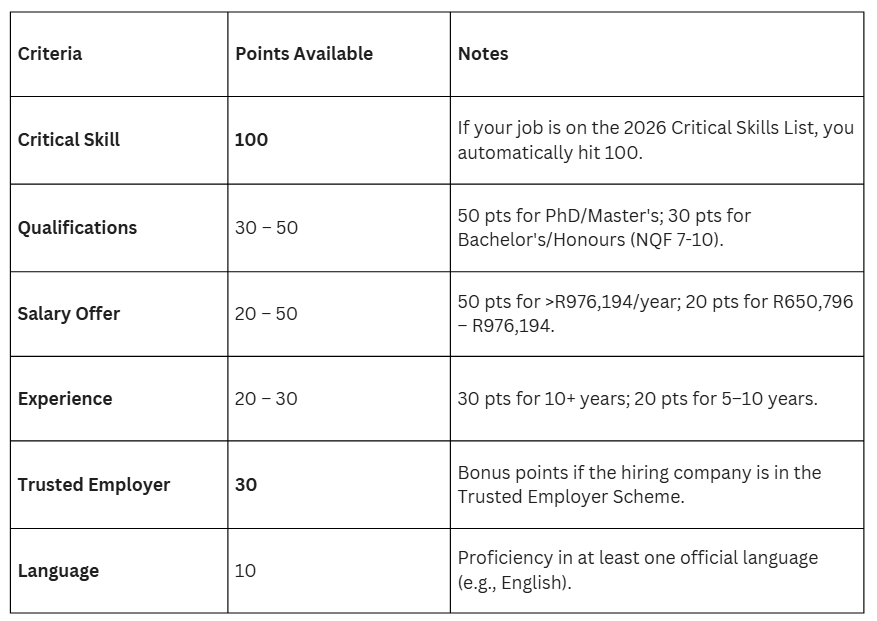
Introduced in late 2024 and fully established in 2026, the PBS applies to Critical Skills and General Work Visas. To qualify, an applicant must score at least 100 points.