Contact Now

The IELTS (International English Language Testing System) is the world’s most recognized English proficiency test for higher education and global migration. In 2026, it remains a gold standard for moving to the UK, Canada, Australia, and New Zealand.
Here is everything you need to know about the test as of March 2026.1. Academic vs. General TrainingYou must choose the correct version based on your goals:
IELTS Academic: Required for university applications (Undergraduate or Postgraduate) and professional registration (e.g., for doctors or nurses).
It focuses on "classroom" English.
IELTS General Training: Required for migration (PR), work visas, or secondary education. it focuses on "survival" English used in social and workplace contexts.
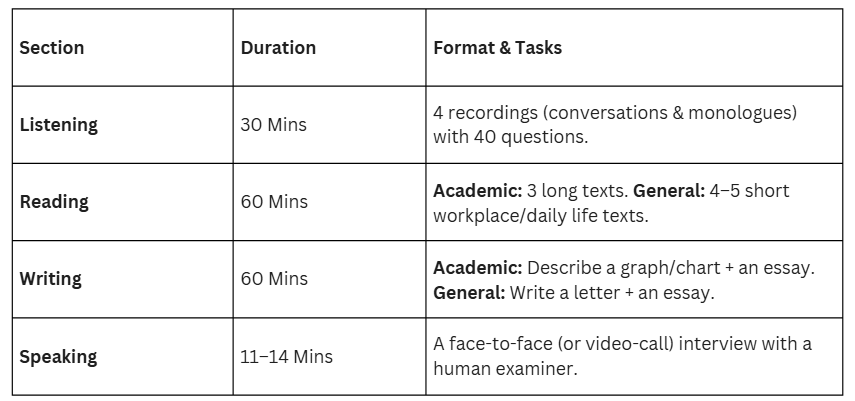
2. The Test Format (2 hours, 45 minutes)
The test consists of four modules. Note that Listening and Speaking are identical for both Academic and General versions.
3. Key 2026 Updates·
One Skill Retake: If you underperform in just one section (e.g., Writing), you can now retake only that section rather than the entire exam. This is widely available for computer-delivered tests.
Writing Tools: For the paper-based test, many centers now require the use of a black pen instead of a pencil to ensure clarity for digital scanning.
Video-Call Speaking: While still "live," many centers now conduct the Speaking test via a high-definition video call with an examiner located elsewhere.
4. Scoring (The 0–9 Band Scale)Your results are reported as "Bands."
Most top-tier universities require an Overall Band of 6.5 or 7.0, with no individual section below 6.0.
Band 9: Expert User·
Band 7: Good User (Standard for most Master's programs)·
Band 6: Competent User (Standard for many Bachelor's programs)Important: The scoring "curve" for Reading is stricter in the General Training version.
Because the texts are easier, you need more correct answers (approx. 34/40) to get a Band 7 compared to the Academic version (approx. 30/40).
The PTE Academic (Pearson Test of English) is a fully computer-based exam favored for its speed and objective AI scoring. In 2026, it remains a top choice for students targeting Australia, New Zealand, and the UK, as well as a growing number of universities in Canada and the USA.
1. Key Features for 2026·
Fastest Results: Scores are typically available within 24–48 hours, making it the best option for tight deadlines.
AI Scoring: There is no human examiner. Your speaking and writing are evaluated by algorithms, which many students find less stressful than face-to-face interviews.·
Integrated Tasks: Unlike IELTS, PTE often tests two skills at once (e.g., "Summarize Spoken Text" tests both Listening and Writing).
Unlimited Score Reporting: You can send your scores to as many universities as you like for free, whereas other tests often charge after the first few reports.
2. PTE Academic vs. PTE CoreIt is critical to choose the right version to avoid your application being rejected:
PTE Academic: For university admissions (Bachelor’s, Master’s, PhD) and student visas globally.
PTE Core: Specifically for Canada PR (Permanent Residency) and work permits. It replaces academic tasks like "Retell Lecture" with practical ones like "Respond to a Situation."
3. Exam Fees in India (March 2026)
As of early March 2026, the standard fee for PTE Academic, PTE Core, and PTE UKVI is:
Current Fee: ₹18,000 (inclusive of 18% GST).
Price Increase Notice: Starting March 16, 2026, the fee is scheduled to increase to ₹18,900. If you book your slot before this date, you can still secure the lower rate.
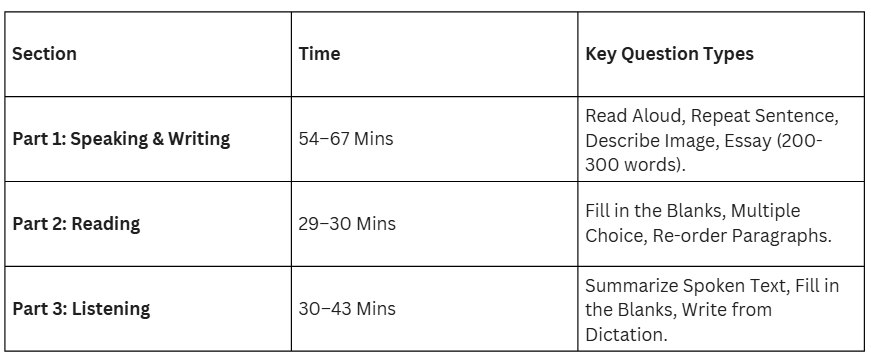
4. Test Format (approx. 2 Hours)
The exam is shorter than it used to be and consists of three main parts:
The TOEFL iBT (Test of English as a Foreign Language) is undergoing its most significant transformation in decades. If you are planning to take the test in 2026, the format, scoring, and even the duration have changed to be more "adaptive" and faster.
Here is the essential breakdown of the New TOEFL 2026:1. The Big Change: Shorter & AdaptiveAs of January 21, 2026, the test has been shortened to approximately 2 hours (down from 3 hours).
Multistage Adaptive Design: In the Reading and Listening sections, the computer adjusts the difficulty of the second set of questions based on how you performed in the first set.
This allows the test to measure your ability more accurately in less time.
Faster Results: You can now see your official scores in your ETS account within 72 hours (3 days), compared to the old 4–8 day wait.
2. New Scoring System (The 1–6 Band Scale)
TOEFL has moved away from the 0–120 total and shifted to a 1.0 to 6.0 scale (in 0.5 increments), similar to IELTS bands.
The Transition Period (2026–2028): Don't worry if your university still asks for the old 0–120 score. For the next two years, your report will show both the new 1–6 band and the traditional 0–120 equivalent.
What is a "Good" Score? 5.5 – 6.0: Expert (C2 level) — Ideal for Ivy League and top-tier research programs.
5.0: Very Good (C1 level) — Generally equivalent to a 95–100 on the old scale.
4.5: Competent (B2 level) — Generally equivalent to an 80–90 on the old scale.
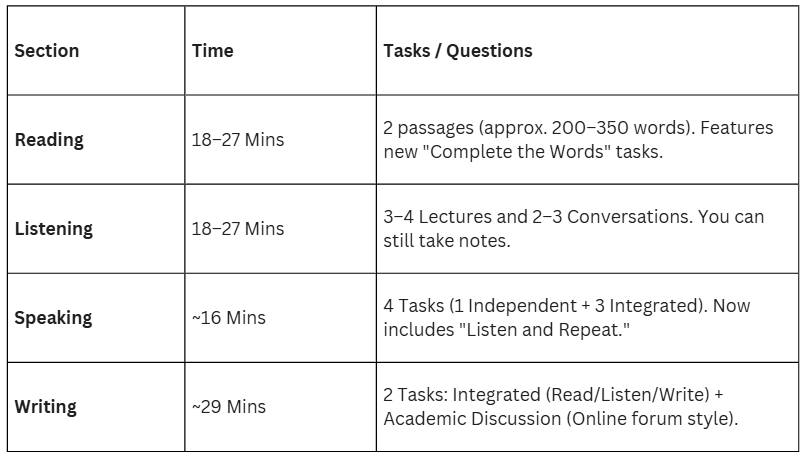
3. Updated Test Structure
The Duolingo English Test (DET) has become one of the most popular alternatives to IELTS and TOEFL due to its convenience and lower cost.
In 2026, it has introduced several "Interactive" updates to better simulate real-world conversations.
1. Key 2026 Updates·
Interactive Speaking: You now participate in a simulated conversation with an animated character, responding to 5–6 adaptive questions based on the flow of the talk.
Enhanced Listening: The "Interactive Listening" task now includes more "Listen and Respond" questions to keep the conversation going, with a summarization task at the end.
Strict ID Rules (India): For 2026, Indian test-takers must use a valid passport. Aadhaar cards, PAN cards, and voter IDs are no longer accepted for identity verification.
2. Fast Facts: Cost & Results·
Affordable Fee: The cost is $70 (approx. ₹6,200) for a single test.
Best Value Bundle: You can buy two tests for $100 (approx. ₹8,800), which is ideal if you want a "practice" attempt.
Result Speed: Standard results arrive within 48 hours. An optional "Fast Results" add-on ($40) can get you your score in just 12 hours.·
Unlimited Sharing: Unlike other tests, you can send your scores to as many universities as you want for free.
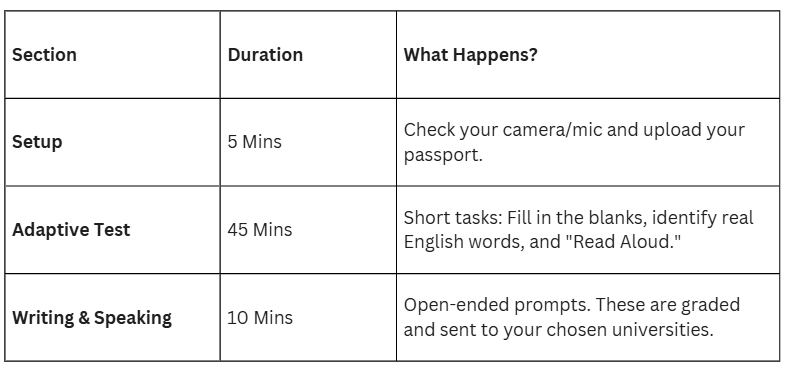
3. Test Structure (Total Time: 1 Hour)
The test is "adaptive," meaning it gets harder as you answer correctly and easier if you struggle.
4. Global Acceptance in 2026
The DET is now accepted by over 5,000 institutions worldwide, including:
USA: Accepted by almost all major universities, including Ivy Leagues like Harvard and Yale.
Canada: Valid for the standard study permit (non-SDS) and accepted by the "U15" top public universities.
UK: Accepted by several Russell Group universities (e.g., Imperial College London, Warwick).
Ireland: Extremely high acceptance; nearly all Irish universities (15 out of 18) now accept it.
Australia/NZ: Increasingly accepted for admissions, though you must check if it satisfies your specific visa subclass.
LanguageCert has rapidly become a preferred "IELTS alternative," particularly for students and professionals heading to the UK.
It is known for its modular structure and the popular "Take2" retake insurance.
1. Key Features & "Take2" Insurance·
Take2 Option: This is LanguageCert’s most famous feature. For a small extra fee at the time of booking, you get a free retake if you fail any part of the exam. Unlike the IELTS "One Skill Retake," which only applies to computer tests, Take2 is a comprehensive safety net.
Modular Flexibility: You can take the Written (Listening, Reading, Writing) and Spoken exams separately or on different days.
You receive two separate certificates, which can be combined for your application.
Human-to-Human Speaking: Even in the online version, the speaking test is conducted with a live interlocutor (a real person), not a computer or AI, which many students find more natural.
2. Test Types for 2026
It is vital to choose the version that matches your visa or university requirements:
LanguageCert Academic: Designed specifically for university admissions (Bachelors, Masters, PhD) and recognized by the UK Home Office and Australian DHA.·
LanguageCert General: Best for work visas (like the UK Skilled Worker) or migration.
International ESOL SELT: If you are applying for a UK Visa, you must take the SELT (Secure English Language Test) version at an approved test center. Home-based online tests are not accepted for UKVI.
3. UK 2026 Rules Update
Starting January 8, 2026, the UK has raised the bar for several visa categories:
Skilled Worker Visa: Now requires B2 Level proficiency (previously B1). This means you need a higher score to qualify for a work permit.
Student Visa (Degree Level): Still requires B2 Level.·
Spouse/Partner Visa: Generally requires A1 Level (Speaking & Listening only).
OETThe OET (Occupational English Test) is a specialized English proficiency exam designed exclusively for healthcare professionals. Unlike general tests like IELTS or PTE, the OET uses real-life medical scenarios—such as patient consultations and referral letters—to assess your communication skills.
1. The 12 Eligible ProfessionsThe OET is not for everyone; you must belong to one of these 12 healthcare fields to take the test:
Medicine (Doctors) & Nursing·
Dentistry, Pharmacy, & Physiotherapy·
Radiography, Occupational Therapy, & Speech Pathology·
Veterinary Science, Dietetics, Podiatry, & Optometry
2. Test Format (approx. 3 Hours)While the Listening and Reading
sections are the same for all professions, the Writing and Speaking sections are tailored to your specific job.

3. Scoring & Grades
OET scores each sub-test on a scale of 0 to 500. These are converted into letter grades:
Grade A (450–500): Very high level of performance.
Grade B (350–440): The standard requirement for most medical boards (e.g., GMC in the UK, ECFMG in the USA).
Grade C+ (300–340): Often the minimum accepted for Nursing Writing in the UK and Ireland.
4. Global Acceptance & Rules·
UK (GMC/NMC): Requires a Grade B (350) in all areas. Nurses can often "club" (combine) scores from two sittings if certain conditions are met.
USA (ECFMG): Doctors must take OET Medicine and score at least 350 in L/R/S and 300 in Writing in a single sitting.
Australia/New Zealand: Generally require a Grade B (350) across all four modules for registration.
The GRE (Graduate Record Examination)
is the most widely accepted standardized test for graduate, business, and law school admissions. Since late 2023, it has transitioned to a "Shorter GRE" format, which remains the standard in 2026.
1. The Shorter GRE Format (2026)
The modern GRE is significantly faster and less exhausting than the older version, lasting just 1 hour and 58 minutes.
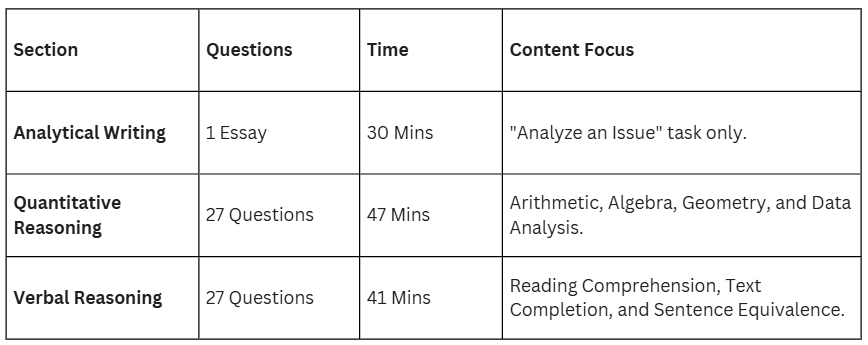
Total Score Range: 260 – 340
(plus a separate 0–6 score for Writing).
2. Key Exam Features·
Section-Level Adaptive: Your performance in the first Verbal and Quant sections determines the difficulty of the second sections. Doing well in the first half "unlocks" harder questions that lead to a higher potential score.
Question Review & Change: Within a single section, you can skip questions, go back, and change your answers.
On-Screen Calculator: A basic four-function calculator with a square root feature is provided during the Quantitative sections.
No Negative Marking: You are not penalized for wrong answers, so you should never leave a question blank.
The SAT (Scholastic Assessment Test)
is a standardized entrance exam used primarily for undergraduate admissions in the USA, Canada, and increasingly in India. In 2026, the exam is fully digital, adaptive, and significantly shorter than the older paper-based version.
1. The Digital SAT Format (2026)
The test now lasts 2 hours and 14 minutes and is taken on a laptop or tablet using the Bluebook app.
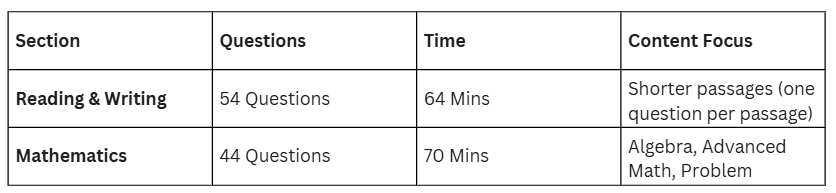
Multistage Adaptive: Each section has two modules.
Your performance in Module 1 determines the difficulty of Module 2.
A stronger performance in the first half leads to "harder" questions that allow for a higher maximum score.·
Calculator Policy: You can use a calculator for the entire Math section. A built-in Desmos graphing calculator is available within the app, or you can bring your own approved handheld device.
No Penalty: There is no negative marking; points are only awarded for correct answers.
2. Scoring & Results·
Total Score: 400 – 1600 (Sum of the two section scores, each 200–800).
Speed: Because it is digital, official scores are typically released in just 2 to 3 weeks (sometimes even faster).
Validity: Scores are valid for 5 years.
3. SAT 2026 Dates & Fees (India)
For students in India, the standard fee is approximately $131 (~₹11,800), which includes the international regional fee and 18% GST.
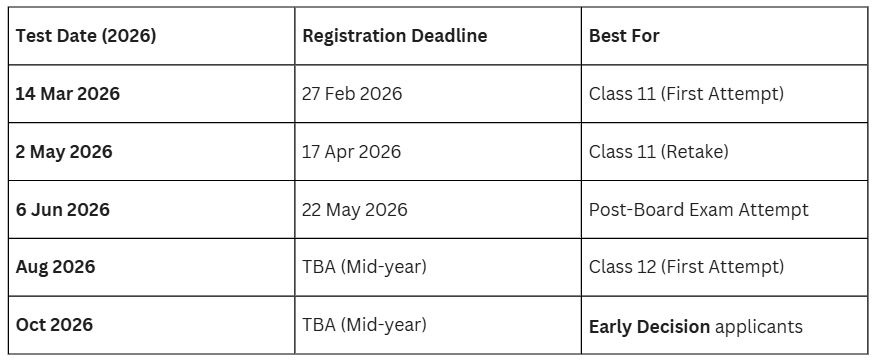
4. Scholarships:
The "India Scholars Program"The College Board offers a unique initiative for Indian residents in Class 11 or 12:
Fee Waivers: Families with an annual income below ₹8 Lakhs can get a 90% discount (paying only ~₹1,200). Those earning between ₹8–15 Lakhs get a 50% discount.
Merit Scholarships: Any Indian student scoring 1300+ is eligible for merit-based tuition scholarships at participating Indian universities (like Ashoka, Shiv Nadar, and O.P. Jindal) and over 800 US universities.
The GMAT (Graduate Management Admission Test) is the gold standard for MBA and business school admissions. Since late 2023, the exam has transitioned to the GMAT Focus Edition, which is the only version available in 2026. This new format is shorter, more flexible, and eliminates the essay (AWA) entirely.
1. The GMAT Focus Edition Structure
The test is now 2 hours and 15 minutes long (excluding breaks) and consists of three equally weighted sections.
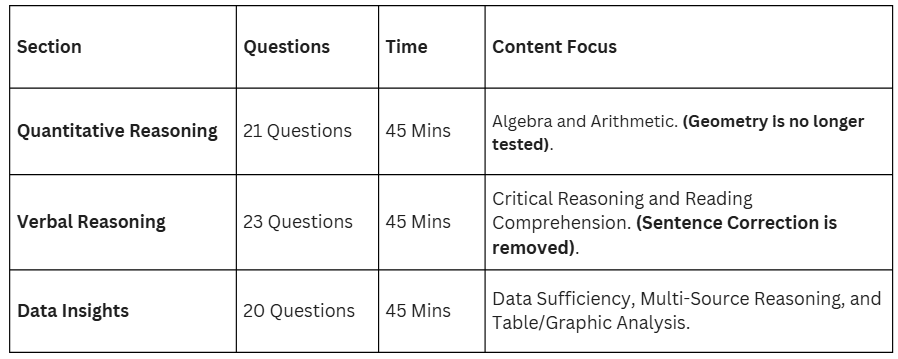
Your Choice of Order: You can choose to take these three sections in any order you prefer (e.g., Verbal first, then Quant, then Data Insights).
Question Review & Edit: For the first time, the GMAT allows you to bookmark questions. You can go back and change up to 3 answers per section if time remains.·
Adaptive Nature: The test is "Question-Adaptive." If you answer correctly, the next question gets harder; if you miss one, it gets easier.
2. Scoring System (205 – 805)
The scoring scale has changed to avoid confusion with the old version (which was 200–800).
Total Score: Ranges from 205 to 805 in 10-point increments.
Section Scores: Each of the three sections is scored from 60 to 90.
Percentile Shift: Because the new scale is tougher, a 645 on the Focus Edition is roughly equivalent to a 700 on the old GMAT.